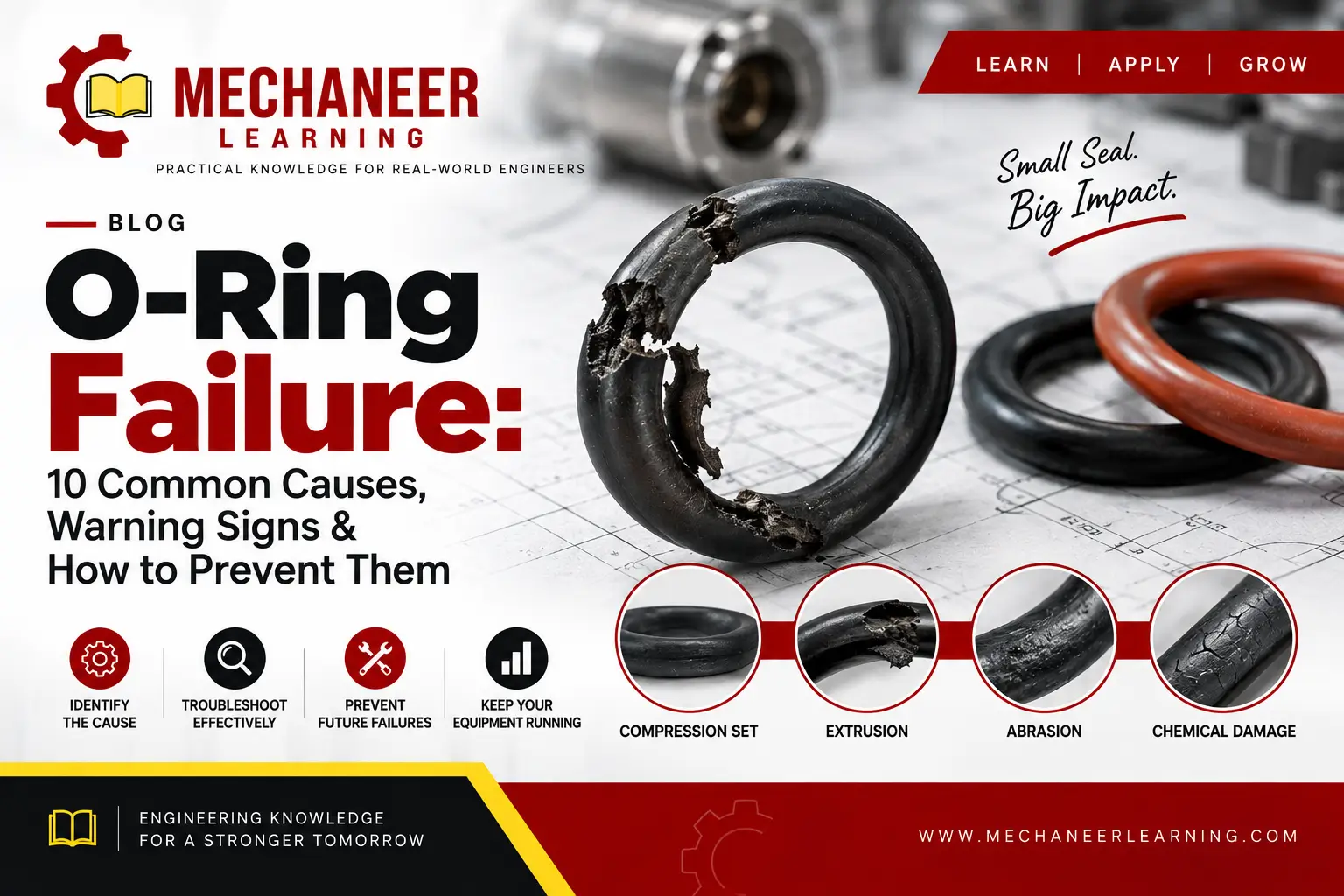
O-Ring Failure: 10 Common Causes, Warning Signs & How to Prevent Them
An O-ring is one of the simplest components in a mechanical system, yet its failure can cause leakage, equipment downtime, contamination, reduced efficiency, and damage to other components.
When an O-ring fails, replacing it with another identical seal may seem like the obvious solution. But if the underlying cause remains, the replacement may fail in exactly the same way.
For engineers and maintenance professionals, the more useful question is:
Why did the O-ring fail?
O-ring failure can result from incorrect material selection, excessive pressure, poor groove design, high temperature, chemical incompatibility, inadequate lubrication, installation damage, or several conditions acting together.
Understanding the appearance and location of seal damage can help you identify the likely failure mechanism and prevent it from happening again.
This guide examines 10 common O-ring failure modes, their warning signs, possible causes, and practical ways to reduce the risk of failure.
What Is O-Ring Failure?
O-ring failure occurs when the seal can no longer maintain the required barrier between two mating surfaces.
Failure does not always mean that the O-ring has completely broken.
An O-ring may appear intact while no longer providing an effective seal because it has:
- Permanently deformed
- Hardened
- Softened
- Swollen
- Cracked
- Worn
- Extruded
- Lost elasticity
- Suffered surface damage
This is why visual inspection of a failed O-ring can provide valuable troubleshooting information.
Instead of immediately throwing the damaged seal away, examine it.
Its condition may tell you what happened inside the equipment.
Quick Guide to Common O-Ring Failure Modes
| Failure Mode | Common Appearance | Possible Cause |
|---|---|---|
| Compression set | Permanently flattened | Heat, excessive squeeze or material degradation |
| Extrusion | Ragged or damaged edges | High pressure or excessive clearance |
| Abrasion | Scratched/worn surface | Friction or rough mating surfaces |
| Chemical attack | Swelling, cracking or softening | Incompatible fluid/material |
| Thermal damage | Hardening or cracking | Excessive temperature |
| Spiral failure | Twisted or spiral cuts | Dynamic movement |
| Installation damage | Cuts or nicks | Sharp edges/improper assembly |
| Explosive decompression | Blisters or internal ruptures | Rapid pressure reduction |
Let’s examine these and other common causes in greater detail.
1. Compression Set
Compression set is one of the most recognizable O-ring problems.
An elastomer should deform when compressed and retain enough elasticity to maintain sealing contact. Over time, however, the material may lose its ability to recover.
When removed, the O-ring may appear flattened rather than returning toward its original round cross-section.
Possible causes include:
- Excessive operating temperature
- Excessive squeeze
- Long-term compression
- Material aging
- Incorrect elastomer selection
How to reduce the risk
Select an elastomer appropriate for the application’s temperature and fluid conditions, and ensure the gland provides suitable compression.
Simply increasing O-ring squeeze is not necessarily an improvement. Excessive squeeze can create additional stress and accelerate permanent deformation.
2. O-Ring Extrusion
Extrusion occurs when pressure forces part of the O-ring into the clearance gap between mating components.
The affected edge may appear:
- Nibbled
- Torn
- Ragged
- Shaved
- Damaged around one side
Extrusion becomes particularly important as system pressure and component clearances increase.
Possible causes
- Excessive clearance
- High pressure
- Pressure spikes
- Incorrect material hardness
- Poor gland geometry
Prevention
Engineers should evaluate the relationship between pressure, clearance, elastomer hardness, groove design, and support of the seal.
In demanding applications, an appropriate backup ring may also be considered as part of the sealing design.
3. Abrasion and Excessive Wear
Abrasion is particularly relevant in dynamic applications where another component moves against the O-ring.
Repeated sliding can gradually remove material from the seal.
Look for:
- Flattened wear areas
- Scratches
- Rough surfaces
- Material loss
- Leakage that gradually becomes worse
Common causes include:
- Poor lubrication
- Rough surface finish
- Contamination
- Excessive friction
- Misalignment
- High cycling rates
The damaged O-ring is sometimes only the symptom. Inspect the mating component as well.
A new O-ring running against the same damaged surface may quickly experience the same problem.
4. Chemical Degradation
O-rings operate in contact with oils, fuels, gases, hydraulic fluids, cleaning agents, water, chemicals, and many other substances.
Not every elastomer is compatible with every medium.
An incompatible environment can cause an O-ring to:
- Swell
- Shrink
- Soften
- Harden
- Crack
- Lose strength
- Lose elasticity
For example, selecting an elastomer based solely on temperature resistance while ignoring chemical compatibility can result in premature failure.
Prevention
Before selecting a material, identify the actual operating medium—including lubricants and cleaning chemicals that may contact the seal.
Material selection should consider the complete operating environment, not just the primary process fluid.
5. Excessive Temperature
Temperature has a major influence on elastomer behavior.
Exposure beyond the appropriate operating range can accelerate aging and change the mechanical properties of the O-ring.
Heat-related damage may appear as:
- Hardening
- Cracking
- Loss of elasticity
- Permanent deformation
- Brittle surfaces
Very low temperatures can also be problematic because some elastomers become less flexible as temperature decreases.
Engineers should therefore consider:
- Normal operating temperature
- Startup temperature
- Shutdown conditions
- Temporary temperature peaks
- Environmental temperature
The maximum number on a material datasheet should not automatically be treated as the ideal continuous operating condition.
6. Installation Damage
Some O-rings fail before the machine has completed its first operating cycle.
During installation, an O-ring may pass across:
- Threads
- Sharp corners
- Keyways
- Ports
- Burrs
- Machined edges
Any of these can cut or nick the elastomer.
Even small damage can become a leakage path once the system is pressurized.
Better installation practices include:
- Inspecting the groove before assembly
- Removing burrs where appropriate
- Keeping components clean
- Using suitable installation tools
- Applying compatible lubrication where required
- Avoiding twisting
- Avoiding excessive stretching
Never assume that because an O-ring looks simple, installation technique does not matter.
7. Spiral Failure
Spiral failure can occur in reciprocating applications when part of an O-ring rolls or twists rather than sliding uniformly.
The resulting damage may form a characteristic spiral pattern around the seal.
Possible contributing conditions include:
- Poor lubrication
- Uneven friction
- Incorrect groove geometry
- Excessive squeeze
- Surface-finish problems
- Misalignment
This is a good example of why O-ring troubleshooting should extend beyond material selection.
The seal may be perfectly compatible with the fluid yet still fail because of mechanical conditions.
8. Explosive Decompression
Explosive decompression—sometimes called rapid gas decompression—is a specialized failure mechanism associated with pressurized gas service.
Gas can permeate into an elastomer while the system is under pressure.
If pressure is reduced too rapidly, trapped gas may expand faster than it can escape from the material.
The O-ring can develop:
- Blisters
- Internal cracks
- Pits
- Splits
- Ruptures
This failure mode demonstrates why engineers must understand both the operating pressure and how that pressure changes during operation.
9. Incorrect O-Ring Size or Groove Design
Even the correct elastomer can fail when installed in an incorrectly designed gland.
Important dimensions and conditions include:
- O-ring cross-section
- Groove depth
- Groove width
- Stretch
- Squeeze
- Gland fill
- Diametrical clearance
A groove that is too shallow may excessively compress the seal.
A groove that is too deep may provide insufficient sealing compression.
Insufficient space can also restrict how the elastomer deforms under operating conditions.
This is why groove design is a fundamental part of O-ring engineering—not simply a manufacturing detail.
10. Contamination
Small particles can have a surprisingly large effect on sealing performance.
Dirt, metal particles, process debris, or other contamination may become trapped between the O-ring and sealing surface.
This can cause:
- Scratching
- Abrasive wear
- Leakage paths
- Surface damage
- Accelerated seal deterioration
Cleanliness during storage, assembly, and maintenance is therefore important.
O-rings should also be inspected before installation rather than installed directly without checking their condition.
How Do You Diagnose an O-Ring Failure?
A useful troubleshooting process begins before installing the replacement seal.
When possible, preserve and inspect the failed O-ring.
Ask:
- Where is the damage located? One side, both sides, or around the complete circumference?
- What does the damage look like? Is the seal flattened, cracked, swollen, cut, worn, or extruded?
- Did operating conditions change? Consider pressure, temperature, fluid, cycle rate, and maintenance changes.
- Is the groove correct? Check dimensions, clearance, squeeze, and surface condition.
- Was the correct material installed? Verify the actual O-ring rather than assuming it matches the specification.
- Could installation have caused the damage? Inspect threads, edges, ports, tools, and assembly procedures.
A failed O-ring is evidence. Treat it as part of the root-cause investigation.
How Can O-Ring Failure Be Prevented?
There is no single solution because O-ring reliability depends on the complete sealing system.
A better approach is to evaluate five areas:
Material: Is the elastomer compatible with the fluid and temperature?
Geometry: Does the gland provide suitable squeeze, fill, stretch, and clearance?
Operating conditions: Are pressure, movement, speed, and temperature within the intended design range?
Surfaces: Are the mating surfaces appropriately finished and free from damaging defects?
Installation: Was the O-ring installed cleanly without cuts, twisting, excessive stretching, or contamination?
When failures repeatedly occur, simply purchasing a supposedly “better” O-ring may not solve the problem.
Find the failure mechanism first.
Learn O-Ring Failure Analysis with Mechaneer Learning
At Mechaneer Learning, we focus on connecting mechanical engineering principles with situations engineers and technicians encounter in real equipment.
Our O-Rings Essentials course covers three important areas:
- O-ring basics, sizing, and common applications
- Groove design principles
- Quality, extrusion, and common failure modes
The objective is not simply to recognize an O-ring.
It is to understand how material selection, groove geometry, pressure, movement, installation, and operating conditions work together to determine sealing performance.
That knowledge can help engineers move from repeatedly replacing failed components toward identifying and correcting their root causes.
Final Thoughts
An O-ring failure should not automatically lead to the conclusion that “the seal was bad.”
The seal may instead be revealing a larger problem.
Extrusion can point toward excessive clearance or pressure. Abrasion can indicate friction, contamination, or surface problems. Swelling may suggest chemical incompatibility. Permanent flattening can indicate compression set, while cuts may trace back to installation.
The key principle is simple:
Don’t just replace the failed O-ring—study it.
Understanding what the damage is telling you can lead to better troubleshooting, better seal selection, improved equipment reliability, and stronger practical engineering skills.